
You’ve tried to make your goals fit into your calendar.
You’ve tried to find more time.
What if the problem isn’t time at all?
Hi, I’m Coach Tony. This is a Project Manage Your Life (PMYL) Pro Tip. It’s one of the tools I use to help people set better goals, stay consistent, and actually finish what they start.
Ready for a dad joke?

Before we dive in, here's a groan-worthy dad joke as a little palate cleanser. I promise it will be worth every penny you paid for it. 😂

Somebody said you could bathe pigs in vodka. That sounds like Absolut Hogwash.
It’s Not Your Calendar
Most people think time management is about squeezing more into their calendar.
It’s not.
It’s about focus.
Throughout February, we’ve been dismantling the phrase “I’m too busy.”
You’ve mapped where your time is actually going.
You’ve replaced “too busy” with “not a priority.”
You’ve blocked time.
You’ve stacked habits.
And yet, your goals still feel just out of reach.
Why?
Because you’re trying to focus on everything at once.
That’s exhausting.
You don’t need to focus on the rest of the year.
You don’t need to focus on the next six months.
You need to focus on the next two weeks.
Anyone can focus for two weeks.
That’s where real progress begins.
Marathons and Sprints
Big goals are marathons. They require endurance, persistence, and long-term vision.
But execution should not feel like running 26.2 miles without stopping.
This is where sprinters have it right.
Sprinters don’t think about the entire season. They focus on the distance directly in front of them. They eliminate distractions. They run hard, cross the finish line, and reset.
That is how progress actually happens in real life.
Not in massive, perfect plans.
In focused bursts.
Sprinting to Success
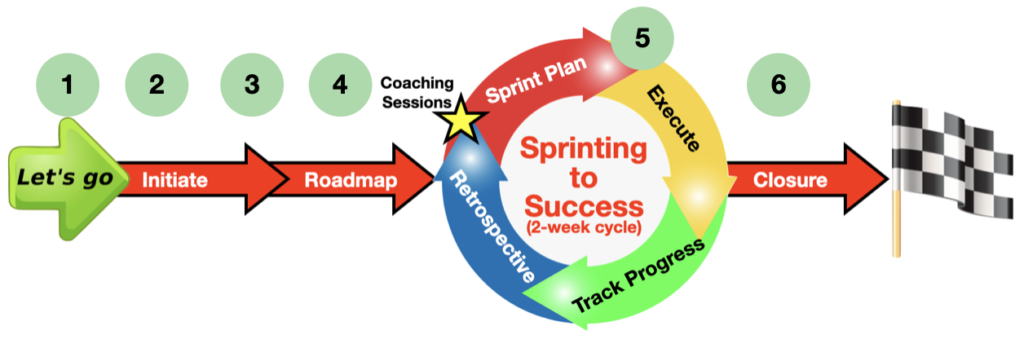
Inside the Project Manage Your Life framework, Stage 3 is called Sprinting to Success. It’s where the plan meets action.
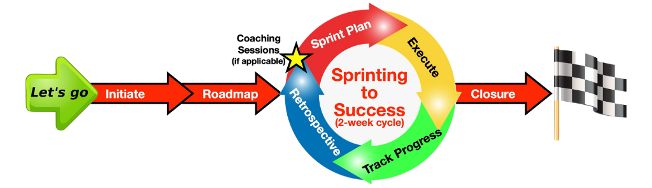
We execute in focused, two-week increments.
Why two weeks?
Because you don’t know what you don’t know.
It’s impossible to predict every twist, turn, obstacle, or opportunity at the beginning of a goal journey. Two-week sprints allow you to take meaningful action now while staying flexible enough to adjust as you learn and grow.
After more than twenty years of managing projects, I’ve seen what works and what fails.
Huge upfront plans fail.
Rigid long-term commitments stall.
Overplanning delays momentum.
Two-week cycles work.
They create urgency without panic.
They provide structure without rigidity.
They build momentum without burnout.
Two weeks is long enough to build traction.
Short enough to feel safe.
Long enough to produce measurable progress.
Short enough to adjust before drift sets in.
You are not committing to a new life.
You are committing to the next 14 days.
The 2-Week Sprint Cycle
Here’s how it works.
Sprint Plan:
Choose a few meaningful tasks that move you closer to your goal. Not twenty. A few.
Execute:
Protect the time and do the work.
Track Progress:
Measure daily. Stay aware. Small data beats vague feelings.
Retrospective:
At the end of two weeks, reflect.
- What worked?
- What didn’t?
- What measurable progress did you make?
- What will you adjust for the next sprint?
Then repeat.
Every sprint is a contained experiment.
If your plan changes, you’re not getting it wrong. You’re adapting like a pro.
The Psychological Relief
If you’re feeling overwhelmed, it’s probably not because the goal is impossible.
It’s because you’re trying to change everything at once.
That’s exhausting.
But you can focus for 14 days.
You can test a new behavior for 14 days.
You can protect 30 minutes a day for 14 days.
You can measure progress for 14 days.
Two weeks lowers the pressure.
It removes perfection.
It eliminates the fantasy that you need the perfect plan before you begin.
You don’t need to know what the next six months look like.
You need to know what the next 14 days look like.
Try This
What is one goal you’ve been postponing because it feels too big?
Instead of asking how you will finish it, ask:
What meaningful progress could I make in the next two weeks?
Define it clearly.
Block the time.
Run the sprint.
At the end of 14 days, review your progress and decide what’s next.
Then run another sprint.
Repeat until done.
You are never more than two weeks away from measurable progress.
Are You Too Busy for a Sprint?
If you’ve been telling yourself you’re too busy to make progress, this is your invitation to test that belief.
Join my next Goal Crusher Coffee Chat:
None of Your Busyness
A time machine for people who feel “too busy.”
In this session, I’ll walk you through the practical steps my clients use to reclaim 30 minutes a day.
Then we will turn those practices into action. During the roundtable portion of the chat, we will challenge ourselves with one powerful question:
What’s one step you could take to find 30 minutes each day to work on something that matters to you?
Then you can put those steps to the test in your next two-week sprint.
You’re not committing to forever.
Just 14 days.
Save your spot below, or visit OperationMelt.com/CoffeeChat, and let’s make your next sprint count.

💥 What feels like a lack of time for your goals may actually be overwhelm, not time. One of the simplest ways to break through that overwhelm is to narrow your focus. Turn your marathon of a goal into a sprint and commit to the next two weeks. When you focus, execute, learn, and repeat, the overwhelm fades and real progress begins.
You’re here for a reason. Let’s take the next step.

Meet Coach Tony
Tony Weaver is a master life coach, technologist, consultant, writer, and founder of Operation Melt.
He helps project managers and other left-brained high-achievers pursue their biggest goals.
Through free resources, personalized coaching, and his proven Project Manage Your Life system, Tony empowers clients to move their dreams from “someday” to success… one step at a time.
Learn more about Project Manage Your Life, the system my clients and I use to crush our goals, at OperationMelt.com/PMYL/
 Meet Coach Tony